Oven Repair
How to Change a Wolf Oven Light Bulb, Series by Series
Entered by
Shauna Delacroix
Cooking-appliance technician — gas ignition · 15 years in the trade
The clicking is the igniter doing its job, so she starts where gas and spark are supposed to meet. Nine calls in ten end at a cap seated wrong or an electrode cracked at the ceramic.
Licensed, bonded and insured
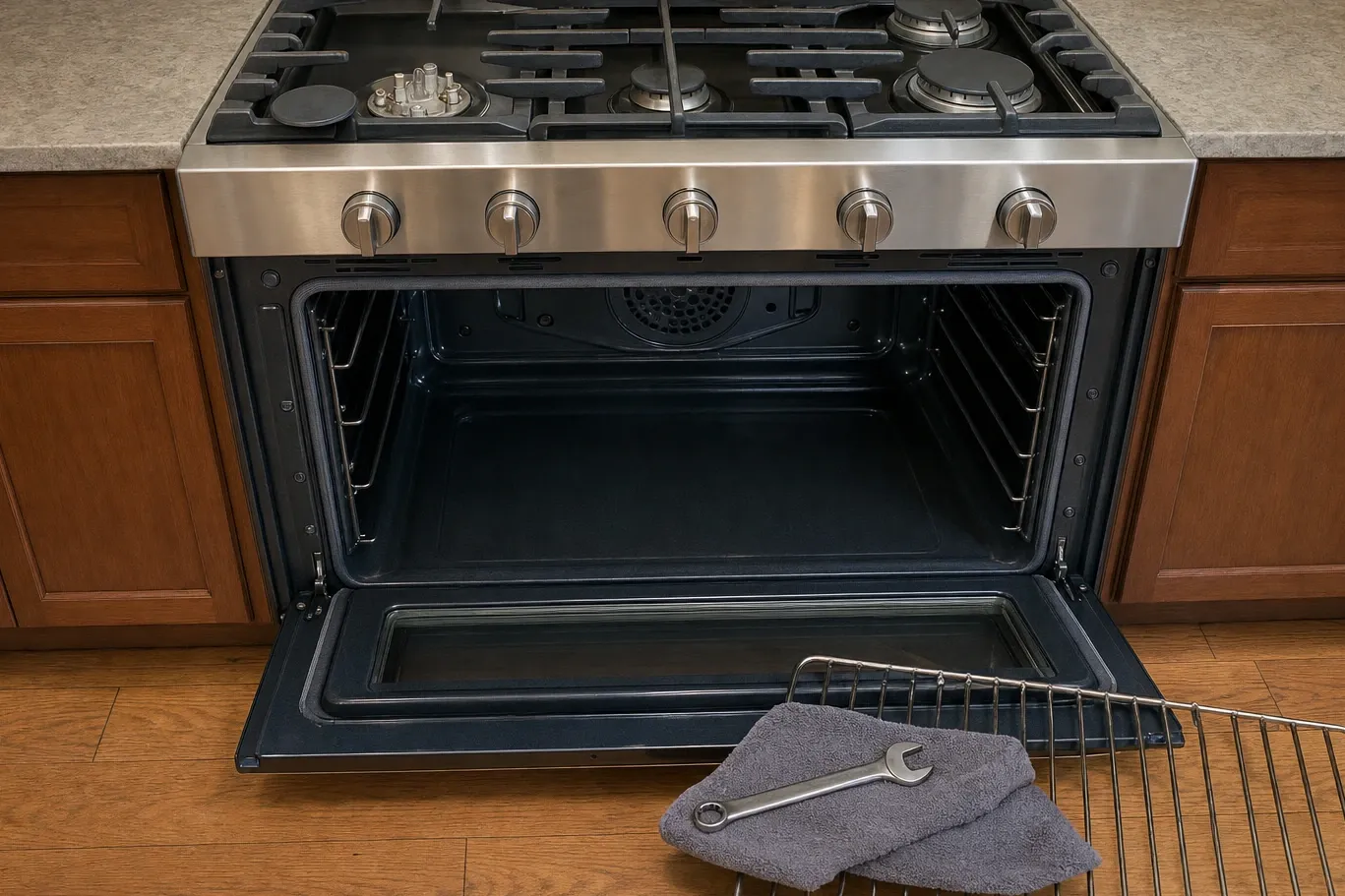
Changing a Wolf oven light is normally a short job: turn the oven off at the breaker, wait until the cavity is cold, lift the glass cover away with a flat screwdriver and push in a new halogen bulb of exactly the same wattage. The right bulb depends on which oven you own. Wolf’s L Series wall ovens take a 20-watt halogen, E Series ovens take a 40-watt halogen, and on E Series models the lamp fixed at the top of the cavity is one Wolf says should be changed by a service technician rather than by the owner. A dark oven matters more than it sounds, because the window is how you judge a roast without opening the door and losing heat.
What the oven light is and why it burns out
The light is a compact halogen lamp sitting behind a heat-resistant glass lens in the wall or ceiling of the cavity. It is switched by the same electronics that run the bake and broil circuits: press the light key, or on many ovens simply open the door, and the control closes a relay that sends power to the lamp. Halogen lamps cope with oven heat far better than a household bulb, but they are still consumables: the filament is fine wire, and every heat-up and cool-down flexes it a little.
A few habits make that happen sooner. Fingerprints on the glass envelope leave oil that cooks into a hot spot, which is why these bulbs should only be handled through a cloth or a glove. A lens left sitting loose lets grease and steam drift into the socket. And a lamp of higher wattage than the oven calls for runs hotter than the socket and cover were built to take, so never upgrade for extra brightness.
Identify your Wolf oven before buying a bulb
Wolf has built several generations of wall oven, and they do not all use the same lamp, so confirm which one you have first. The model number carries most of the answer. It begins with SO for a single oven, DO for a double oven or CSO for a convection steam oven. The letters that follow name the family: TM, PM and CM mark M Series Transitional, Professional and Contemporary, while TE and PE mark E Series Transitional and Professional.
To read the number, open the oven door. On M Series and E Series SO3050/DO3050 ovens the serial tag is near the bottom trim on the left-hand side, and on a double oven you look in the lower cavity. Convection steam and speed ovens keep their tag on the left of the front face frame instead. Photograph it; a parts counter or technician will ask for it first.
| Oven family | Replacement lamp | Who changes it |
|---|---|---|
| L Series | 20-watt halogen | The owner, with power cut at the breaker |
| E Series | 40-watt halogen | The owner, except the top-of-cavity lamp, which goes to service |
| M Series | As listed in your use and care guide | Follow the guide for your model |
Swapping the bulb, step by step
These steps follow Wolf’s instructions for L Series ovens. Other families work on a similar idea, but check your own guide for how the cover is held.
- Switch the oven off and leave it until it is completely cold. The lamp and its lens hold heat long after the cavity air has cooled.
- Cut power at the electrical box rather than relying on the touch panel. In a Gold Coast high-rise unit the breaker panel is often in a closet inside the apartment, while in an older Bucktown or Lakeview two-flat it may be down in the basement, so label the oven breaker while you are standing there.
- Take out any racks that block your reach and lay a folded towel on the oven floor to catch a dropped lens.
- Slip the blade of a flat screwdriver under the edge of the light cover and pry gently. Work your way around the rim instead of forcing one spot, since the glass will crack before it bends.
- Remove the old lamp from its socket and look closely at the base so the replacement matches it.
- Holding the new halogen bulb in a cloth, press it fully home. Keep bare fingers off the glass.
- Wipe the lens, press it back until it sits evenly all the way round, restore the breaker and try the light key.
The lamp you should leave alone
On E Series ovens, Wolf states that the bulb at the top of the cavity must be replaced by service. There is no owner procedure published for it, and levering at a housing that was never meant to come apart from inside the oven is an easy way to crack glass or pull a wire loose. The good news is that a dead top lamp does not stop the oven cooking. Carry on baking, and have the bulb changed on a planned visit rather than treating it as urgent.
A fresh bulb that still stays dark
When a new lamp of the correct wattage does nothing, the fault sits somewhere between the control and the socket. Work through it from the simplest cause to the most involved:
- The bulb is not fully seated, or the new one was dead out of the packet. Reseat it and try a second lamp before anything else.
- The socket has scorched or corroded, which usually shows as a brown or blackened ring around the contacts.
- The door switch or the light key is no longer telling the control to switch the lamp on.
- The relay that feeds the lamp has failed. Legacy E Series ovens report this with a code of their own: 07 x 22 means an open oven light relay, part of the same group as 07 x 13 through 07 x 16 for the bake, broil and convection relays. Wolf publishes no owner fix for any of them.
Sockets, switches and relays all sit behind panels carrying line voltage, so this is the point where a homeowner should stop and book a technician. Our oven repair service covers that diagnosis for Lincoln Park, Lakeview, Gold Coast and Bucktown. If the oven also seems to be baking slowly, our guide to reading an oven that runs cold shows how to take a temperature check worth trusting before anyone opens a panel.
What a visit costs
Our visits start with a flat $89 service call that pays for the technician coming out and working out exactly what is wrong; approve the repair and we credit it back. A bulb swap alone rarely justifies a visit, but add it to the list when a technician is already booked. If the trouble traces back to the electronics, a control board or touch panel repair typically lands in the $470–$910 range. The firm price follows the diagnosis. To book, call (312) 971-3506 or use the booking button on this page.
Follow-ups
- What bulb does a Wolf oven light take?
- That depends on the oven family. Wolf's L Series ovens use a 20-watt halogen lamp and E Series ovens use a 40-watt halogen lamp. For an M Series oven, or one you cannot identify, look up the use and care guide for the model number printed on the serial tag inside the door, and match the base of the old bulb exactly.
- How do I replace the light bulb in a Wolf E Series oven?
- Shut the oven off at the breaker, wait for the cavity to go cold, remove the lens over the lamp you can reach and fit a 40-watt halogen bulb while holding it in a cloth. The exception is the lamp at the top of the cavity: Wolf says that one has to be replaced by service, so leave its housing alone.
- Why should I not touch a halogen oven bulb with bare hands?
- Skin oil left on the glass bakes on once the lamp heats, forming a hot spot that can shorten its life or crack it. Wolf warns against touching its E Series replacement bulb, so handle any new lamp through a clean cloth or a glove.
- Is it worth paying for a visit just because the oven light is out?
- Usually not for a lamp you can reach yourself. A visit earns its cost when a fresh bulb still will not light, or when the dead lamp is the top-of-cavity one on an E Series.