Range Repair
Can Your Back Porch Take a 600-Pound Range? Chicago's 100-PSF Porch Rule and the Lincoln Park Two-Flat Delivery Route
Entered by
Shauna Delacroix
Cooking-appliance technician — gas ignition · 15 years in the trade
The clicking is the igniter doing its job, so she starts where gas and spark are supposed to meet. Nine calls in ten end at a cap seated wrong or an electrode cracked at the ceramic.
Licensed, bonded and insured
The call we take most often here
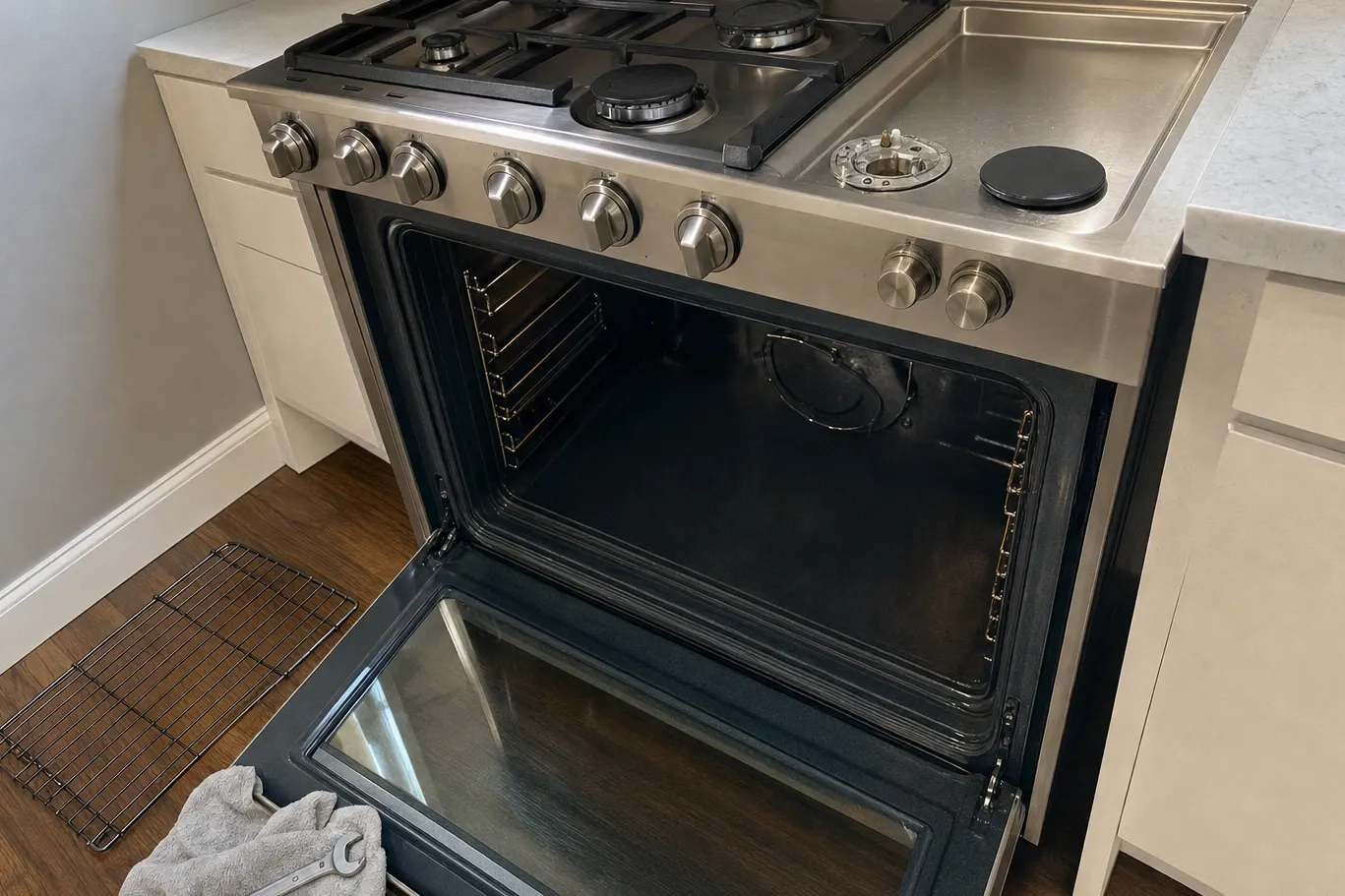
The Chicago call that comes in most often is not a fault at all. It is a delivery that cannot happen. A 48-inch Wolf is on the truck, the kitchen sits at the back of a two-flat, and the only route into it is a rear wooden porch that nobody thought to inspect before the date was booked.
Fronts do not work here. A narrow vestibule, a winder stair and a parlour-floor turn will beat a crated professional appliance every time, and the outgoing unit has to leave by whatever path the new one arrives on. So the porch is not a detail of the job. On this housing stock, the porch is the job.
Why this address produces it
The rear wooden porch is the standard back-of-house structure on the two-flats, greystones, frame houses and rowhouses of Lincoln Park, Lakeview and Bucktown. Chicago requires every element of a porch or deck to support a 100 pound per square foot live load, with permits and inspection governed by the building code and its existing-buildings maintenance provisions at 13-196-570.
Those rules were tightened for a reason. On 29 June 2003 a three-storey wooden rear porch at 713 W. Wrightwood Avenue in Lincoln Park collapsed, killing 13 people and injuring 57 — the deadliest porch collapse in American history. The city acted on 1,260 porch cases in the period that followed. Two decades on, the structure behind a Lincoln Park greystone is either a permitted, inspected, 100-psf porch with a paper trail behind it, or it is something older that has never been assessed, and that distinction decides whether a heavy appliance can physically reach the kitchen.
Gold Coast is the exception on our map: a townhouse or high-rise kitchen there is usually reached by the building’s own service elevator, under rules the owner does not write. Everywhere else in this service area, the back stair is the answer.
The chain, from cause to complaint
A 100-psf figure describes a distributed load spread across a whole surface. A crated appliance on a two-wheel dolly is the opposite of distributed: several hundred pounds concentrated onto two small contact patches that then roll, stop and pivot on a landing. A structure that satisfies the code standing still is not automatically a structure to walk 600 pounds across.
The route fails in a predictable order. Clear stair width goes first, and it must be measured between the handrails rather than between the stringers, because the rails are what the crate actually touches. Landing depth goes second: a 48-inch appliance has to be turned somewhere, and the turn happens on the landing outside the kitchen door. The kitchen door is third, and it is frequently the tightest opening on the whole route. Only after those three does the condition of the framing become the deciding factor.
When one of them fails on the day, the crate goes back on the truck. The old appliance stays where it is, the household keeps working around whatever still lights, and a second attempt has to be scheduled around a porch repair, a window removal or a lift — none of which was in anyone’s plan or anyone’s budget.
Ruling out the obvious first
Measure four things and photograph a fifth, before the delivery date is confirmed. The narrowest clear width on the stair. Landing depth at the top. The kitchen door opening with the door lifted off its hinges. The height of the main floor above grade at the bottom of the run. Then photograph the porch framing from underneath, in daylight.
Compare those numbers against the appliance both crated and bare. The crate is usually the binding dimension and can often be stripped at the foot of the stair; the door, the handle, the backguard and the legs generally come off as well, and removing them in the gangway rather than on a landing keeps the concentrated load lower and the crew’s hands free. Bucktown cottages raised over new lower levels deserve a second measurement — the main floor sits higher above grade than the original stair was ever built to serve.
Check the paperwork while you are at it. If there is an open permit on the porch, or the porch is mid-replacement, the route does not exist on that date, and that is far better learned a week out than at eight in the morning with a truck idling in the alley.
When it stops being a homeowner job
If the framing shows rot at the ledger or at the stringer connections, or nobody can produce a permit for the structure, do not run a delivery over it. That is a question for a licensed structural contractor, not for an appliance crew, and no kitchen upgrade is worth the alternative.
Our own work starts once the machine is standing in the kitchen. The diagnostic visit is $89, and repairs price by the fault: igniter or spark module, $170 to $460; burner valve or orifice service, $250 to $560; oven thermostat or sensor calibration, $200 to $420; convection fan or motor, $280 to $670; control board or touch panel, $470 to $910; door hinge, glass or seal, $270 to $730.
That list is worth reading before deciding an ageing appliance has had its day. Every line on it is work done to a machine already standing in your kitchen, and not one of them requires anything to be carried up the back stairs. When the answer honestly is replacement, at least you will have measured the route before the truck is booked rather than after. Call (312) 971-3506 and we will start with the fault.
Follow-ups
- Does my Chicago back porch have to hold 100 pounds per square foot?
- Yes. The city requires every element of a porch or deck to support a 100 pound per square foot live load, with permits and inspection under the building code and its maintenance provisions at 13-196-570. That is a distributed figure, though. A loaded dolly puts several hundred pounds onto two wheels, so a porch that meets the standard at rest still deserves a proper look before a delivery crosses it.
- Can a 48-inch range be brought in through the front of a two-flat?
- Rarely in Lincoln Park or Bucktown. The vestibule, the winder stair and the parlour-floor turn together defeat most crated 48-inch units, which is why the rear porch and back stair are the working route on this housing stock. Measure the clear stair width between handrails, the landing depth at the top, and the kitchen doorway with its door taken off, before anyone commits to a delivery date.
- Our porch is being rebuilt this summer. Should we postpone the delivery?
- Yes. A porch under replacement removes the only usable route into most Lakeview and Lincoln Park kitchens, and neither the incoming appliance nor the outgoing one can be worked around it. Book the delivery for after the new structure has been inspected and signed off. It is also the cheapest moment to widen a stair or deepen a landing, if your measurements say the route was always marginal.